The analytical architecture underpinning HRB's AI advisory practice was developed before the institutional frameworks existed. When the governance wave arrived, the structural foundations were already in place.
AI advisory at HRB is not technology advice. It is structural intelligence on how artificial intelligence reshapes governance, regulatory positioning, institutional capability, and long-cycle competitive architecture.
Four independent recognitions across Agentic AI, Generative AI, AI governance, and strategic advisory. Each assessed through a distinct methodology by a distinct body. Collectively, they validate the analytical depth and governance-first positioning that defines HRB's AI advisory practice.
Recognised alongside UBS, Microsoft, Accenture, PwC, and Cambridge Judge Business School. Independently assessed through Thinkers360's patented thought leadership methodology.
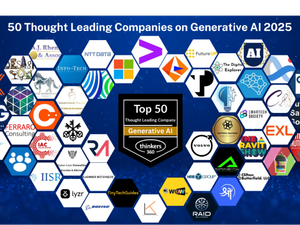
Recognition across both Agentic and Generative AI reflects the breadth and depth of HRB's structural analytical contribution to frontier AI discourse.
Merit-led recognition of leadership at the intersection of structural advisory and AI innovation. Awarded for work conducted through HRB GROUP®.
Direct validation of HRB's position on AI governance as a structural governance question. Awarded for work conducted through HRB GROUP®.
AI advisory at HRB spans six distinct analytical domains, each developed from applied structural work. Select any domain to read its scope and structural problem. The network responds to show how each domain connects to the others.
Select a domain to activate its node. Signals intensify between connected domains.
The design of AI governance frameworks at board and institutional level. Model risk management, algorithmic accountability, escalation architecture, and the structural conditions that make AI deployment both capable and defensible under regulatory scrutiny.
Structural intelligence on agentic AI architectures, multi-agent systems, and autonomous decision frameworks for institutional deployment. Governance design for AI systems that initiate actions without constant human direction.
LLM deployment governance, synthetic data architecture, GenAI risk frameworks, and the institutional conditions under which generative AI creates analytical value rather than operational and reputational risk.
Cross-jurisdictional AI regulatory intelligence covering the EU AI Act, UK AI governance frameworks, US executive orders, and the structural positioning of institutions navigating simultaneous AI regulatory transformation across multiple jurisdictions.
Forward-horizon intelligence on quantum-safe cryptography migration, post-quantum architecture planning, and the structural implications of quantum computing for financial market infrastructure and long-cycle institutional security.
Structural intelligence on the design of AI-native regulated financial products, AI-enabled compliance architecture, and the governance frameworks required to bring AI-native products to market within existing regulatory constraints.
AI is a technology architecture built from models, data structures, and design choices that directly reshape institutional behaviour. The HRB Index Universe measures these structural conditions across AI, capturing how model architectures, technology design, and institutional governance interact.
Across AI, the indices operate through four structural functions. Select any function to read how the indices apply it and what it means institutionally.
Because the indices operate at the architectural layer, HRB's AI advisory is not about model tuning, tooling, implementation, or optimisation. It is about governance, posture, and structural coherence, including the architectural consequences of model design itself.
The indices allow HRB to see upstream structural conditions before they become downstream failures, identify model-driven exposure before it becomes consensus, shape AI adoption in a way that preserves optionality and institutional integrity, and ensure AI strengthens the system rather than destabilising it.
This is what differentiates HRB's AI advisory from technical or operational AI consulting.
The distinction matters because conflating structural AI advisory with technology consulting produces the wrong engagement, the wrong deliverables, and the wrong outcome.
The analytical architecture underpinning HRB's AI advisory practice was developed over multiple years of applied work preceding the firm's formation in 2023. The governance frameworks, the regulatory intelligence, and the structural understanding of how AI reshapes institutional capability were built before the commercial pressure to standardise them existed.
That formation is what distinguishes the practice analytically. The Oxford AI Book contribution, the UK House of Lords and House of Commons engagement, and the Thinkers360 recognition are markers of when the analytical architecture was operational, not achievements pursued for recognition, but evidence of structural timing.
The analytical architecture underpinning HRB's AI advisory practice was developed over multiple years of applied work preceding the firm's formation. AI governance frameworks, regulatory intelligence, and the structural understanding of how AI reshapes institutional capability were built before the commercial wave, and before the regulatory frameworks that now govern the domain existed.
Contributing author to The AI Book, published by Wiley. A primer on how the financial services industry would be structured and disrupted by AI across finance, business, and investment over the coming decade. Written from research conducted at the University of Oxford, before the mainstream institutional conversation formed.
Strategic observer and contributor to the UK House of Lords and House of Commons on artificial intelligence and financial technology. Engagement at the level where the governance frameworks being applied across institutions are actively being written.
Early structural analysis of agentic AI architectures, multi-agent systems, and the governance implications of autonomous AI for regulated institutions. Thinkers360 Global Top 25 Agentic AI recognition follows. HRB GROUP® formally established.
Contributing author to GBBC GSMI 5.0 UK AI Regulations chapter. Structural intelligence on the UK AI governance landscape contributed at global standard-setting level.
HRB's AI advisory practice reaches canonical form. Recognised across four independent AI awards including Top 50 Agentic AI and Top 50 Generative AI Companies (Thinkers360) and two SME News Managing Director of the Year Awards for AI governance and strategic advisory.
The structural advantage HRB holds in AI advisory is not replicable through research, training, or tool acquisition. It is the product of analytical architecture developed before consensus formed, and a practice designed to operate upstream of the institutions it advises.
Continue Your Journey
The intelligence architecture and the practice it governs.